
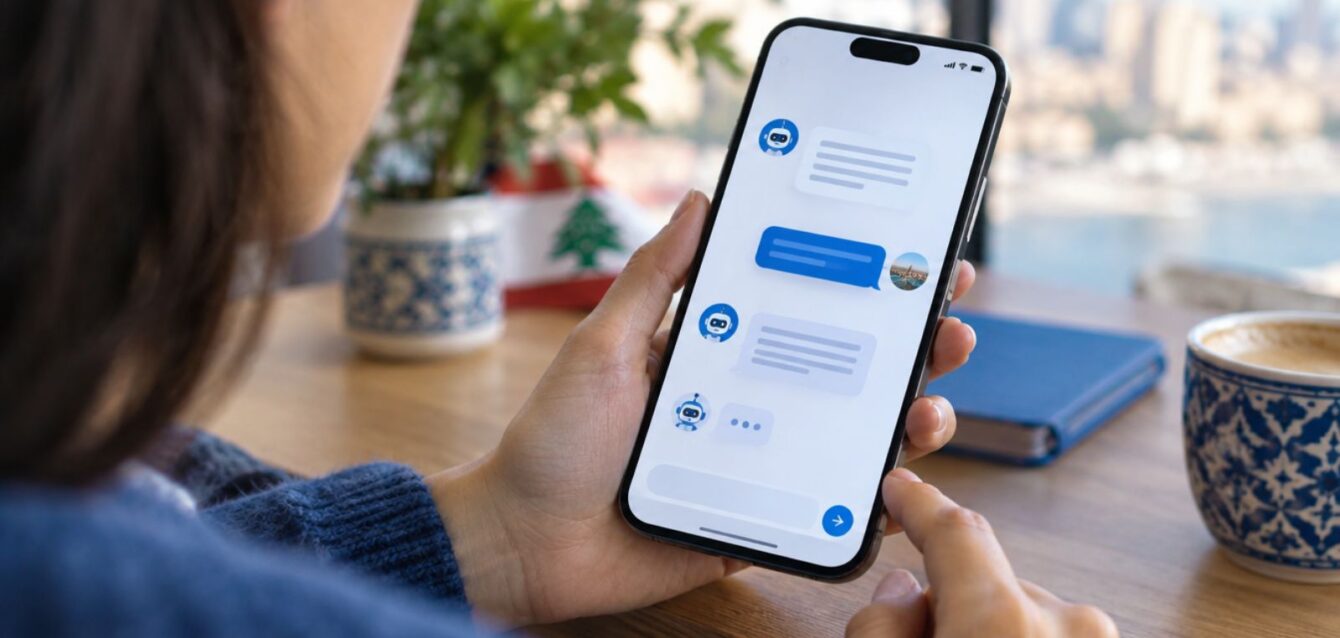
Lebanese customers rarely write in textbook Arabic. A typical message might start in Lebanese dialect, switch to English for a product name, add a French expression and end in Arabizi, Arabic written with Latin letters and numbers. Traditional chatbots built on keyword menus fail almost immediately in this environment. Modern AI language models have changed what is possible, but building an AI chatbot in Arabic that truly understands Lebanese dialect still requires careful design, testing and ongoing improvement. This article explains how to do it.
Why Lebanese dialect is hard for bots
- Dialect vocabulary: everyday Lebanese words differ from Modern Standard Arabic, the form most Arabic language technology was historically trained on.
- Arabizi: many people write Arabic in Latin script using numbers for sounds, such as 3 for ayn or 7 for haa, with inconsistent spelling.
- Code-switching: a single sentence can mix Arabic, English and French.
- Informal spelling: abbreviations, missing letters and voice-note transcriptions add noise.
Large language models trained on vast multilingual data handle much of this far better than older Arabic NLP tools, but quality still varies between models and must be tested with real Lebanese examples.
Step 1: Collect real conversations
Start with the questions your customers actually ask. Export a few hundred anonymized messages from WhatsApp, Facebook, Instagram and email, and listen to a sample of call recordings. Group them into topics: prices, opening hours, order status, appointments, complaints. This dataset becomes both the bot’s knowledge base and its test set.
Step 2: Write approved answers
An AI chatbot should not invent policies. Write clear, approved answers for each topic and store them in a structured knowledge base. Use retrieval-augmented generation (RAG), so the bot searches this knowledge base and answers from it, rather than relying on the model’s general knowledge. This dramatically reduces wrong answers.
Step 3: Choose the reply language
Decide how the bot should respond. Many Lebanese businesses reply in the language the customer used: Arabic to Arabic, English to English. For Arabizi messages, replying in friendly Lebanese Arabic script or in English often works best, but test what your customers prefer. Keep the tone warm and concise, matching your brand.
Step 4: Connect to live data
The most useful bots do more than answer FAQs. Connected to your systems through secure APIs, they can check order status, available appointment slots, account balances or claim progress, and take actions such as booking or reordering. Each connection should be limited to the minimum data needed and protected with proper authentication.
Step 5: Design human handover
No chatbot handles everything. Define clear rules for when the conversation goes to a human: complaints, sensitive topics, repeated misunderstanding, high-value sales or when the customer simply asks for a person. The handover should pass the full conversation to the agent, so the customer does not repeat themselves.
Step 6: Test with Lebanese examples
Before launch, run your collected messages through the bot and score each answer as correct, partly correct or wrong. Include Arabizi, mixed-language and misspelled messages deliberately. Involve staff who speak with customers every day; they will spot unnatural phrasing immediately. Fix the knowledge base and prompts, then test again.
Step 7: Launch on the right channels
In Lebanon, WhatsApp is usually the most important channel, followed by your website and Instagram or Facebook messages. Using the WhatsApp Business API, the same bot can serve all channels with one knowledge base. Start with one channel, monitor closely, then expand.
Step 8: Monitor and improve weekly
Review conversations every week. Look for questions the bot could not answer, handovers that could have been avoided and answers customers rated poorly. Add new knowledge, refine instructions and track metrics such as resolution rate, handover rate, response time and customer satisfaction.
Privacy and security
Tell customers they are talking to an AI assistant, protect personal data, avoid storing sensitive information in chat logs longer than necessary, and make sure your provider does not use your conversations to train public models without consent.
Use cases that work well
- Retail and e-commerce: product questions, order tracking, delivery times.
- Clinics and labs: appointment booking, preparation instructions, result availability.
- Insurers and banks: claim status, branch hours, document requirements.
- Utilities and generator operators: bill amounts, payment reminders, outage information.
Key takeaways
An Arabic AI chatbot that understands Lebanese dialect is achievable today, but success comes from real data, approved knowledge, careful testing and clear handover rules, not from the model alone. Read our overview of AI chatbots for Lebanese businesses for more examples.
Frequently asked questions
Can the bot understand voice notes?
Yes, with speech-to-text, though accuracy for dialect should be tested carefully before relying on it.
How long does it take to launch?
A focused FAQ and booking bot can launch within weeks; deeper integrations take longer.
Explore our AI solutions.
Examples of tricky messages to test
Build a test list that reflects how people really write. Include a short Arabizi question about opening hours, a long message mixing Lebanese Arabic with an English product name, a French greeting followed by an Arabic complaint, a message with heavy spelling mistakes, a question that refers to an earlier message in the same conversation, and a request the bot should refuse or hand over, such as a refund dispute. For each, write the ideal answer before testing, so scoring is objective. Repeat the full test every time you change the knowledge base, the instructions or the underlying model, because improvements in one area can quietly break another.
Measuring success
Define success before launch. Useful measures include the share of conversations fully resolved without a human, the share handed over and why, the average time to first reply, customer ratings at the end of a chat and the number of conversations that led to a booking or sale. Compare these with your previous support metrics, such as average reply time on WhatsApp before the bot, to show the business impact clearly. Most teams see the biggest gains in reply speed outside working hours, when customers previously waited until the next morning for an answer.
Work with Software Senior
Software Senior is a Beirut-based software development, AI and IoT company with more than 15 years of experience in healthcare, insurance, government, energy and enterprise projects. Request a free consultation, call +961 3 014416 or email [email protected]. Answers to common questions are in our FAQ.