A national forensic DNA database is one of the most sensitive and consequential systems a government can operate. It helps solve crimes, exonerate the innocent, identify missing persons and name victims after disasters. Every result it produces may end up in court, so the software behind it must be accurate, traceable and secure by design. This article sets out the core requirements for forensic DNA database software in a national laboratory, based on how forensic labs actually work.
1. Case and evidence management
Everything starts with a case. The software must register cases with their reference numbers, requesting authority, offense type, dates and investigators. Each case may contain many evidence items, such as swabs, clothing, weapons or bones, and each item may produce several samples and extracts. The system should model this hierarchy clearly, so that any result can be traced back to its item and case in seconds.
Reference samples from suspects, victims, relatives of missing persons and elimination samples from lab staff and police must be recorded with their own categories, because the law usually treats them differently for storage, searching and retention.
2. Chain of custody
Chain of custody is the documented history of who handled a piece of evidence, when, where and why. In court, a broken chain can make a result inadmissible. Forensic DNA database software must record every transfer, storage location, analysis step and disposal, ideally using barcodes or RFID scanned at each handover. The record must be tamper-evident: entries cannot be silently edited, and corrections are logged with reasons.
3. Laboratory workflow and analyzer integration
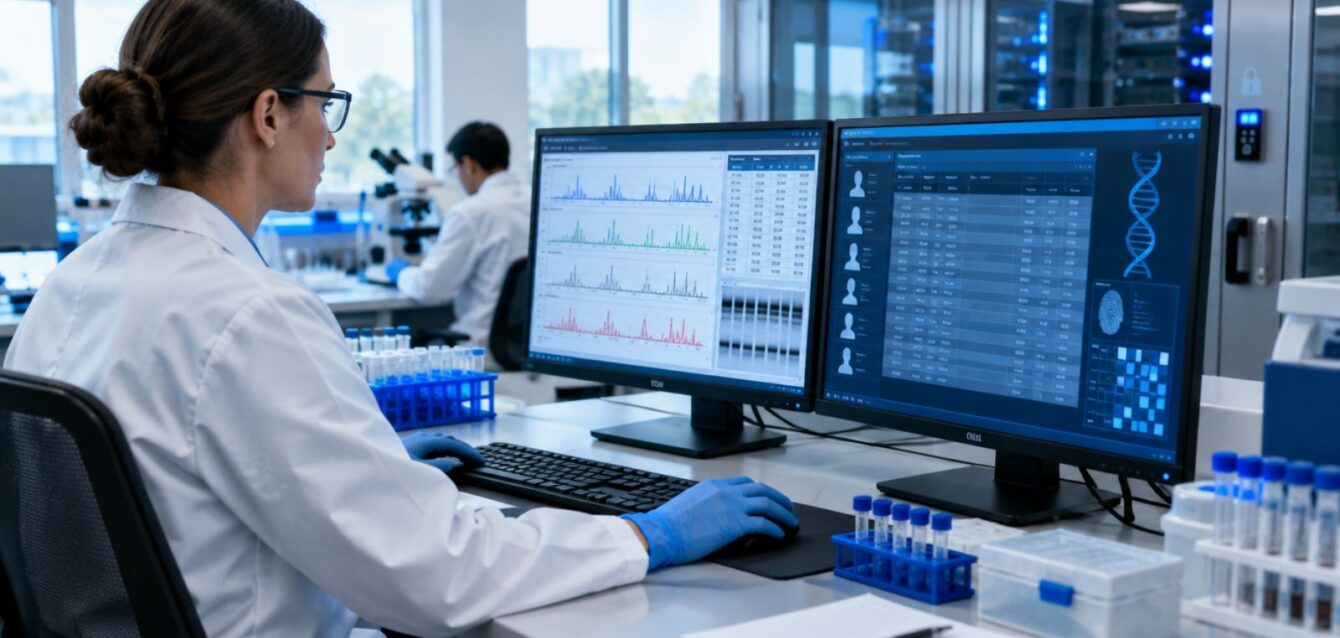
A DNA lab runs extraction, quantification, amplification and capillary electrophoresis, then interprets the resulting profiles. The software should generate worklists and plate layouts, track reagents and kits used for each batch, and import results directly from genetic analyzers and analysis software, instead of having analysts retype allele values. Direct integration removes transcription errors, one of the most serious risks in forensic work. Software Senior built a forensic platform for DNA profiles and chemical data management with integration with DNA machines for exactly this reason.
4. Profile storage and quality
DNA profiles must be stored in a structured, standardized way, with the loci tested, allele values, kit used, mixture indicators and quality flags. Partial and mixed profiles need careful handling: the system should record how many contributors are assumed and which alleles are obligate or uncertain, so that searches use them correctly.
5. Matching and search
The database must search new profiles against existing indices according to approved rules: forensic unknowns against convicted or arrestee indices, against other crime scenes, missing persons against relatives, and so on. Search parameters such as minimum loci, stringency and allowed mismatches must be configurable and documented. Every match should generate a candidate list for expert review, never an automatic conclusion, and the confirmation process must be recorded.
6. Kinship and missing persons
Identifying missing persons and disaster victims requires kinship analysis, comparing unidentified remains with profiles from parents, children or siblings. The software should support pedigree data and likelihood calculations, or integrate with specialist kinship tools, and link identifications back to cases and families.
7. Chemical and reagent tracking
Accredited labs must show which reagents, kits and lots were used for each analysis, and that they were within their expiry dates and validated. Inventory and chemical data management should be part of the same system, so that a problem with one reagent lot can be traced to every affected result.
8. Security architecture
Security is non-negotiable. Requirements typically include:
- Role-based access control, with separation between case managers, analysts, reviewers and administrators.
- Strong authentication, ideally with two factors.
- Encryption of data in transit and at rest.
- Network isolation of the database from the internet.
- Complete, immutable audit logs of every view, search and change.
- Regular security testing and documented incident response.
9. Accreditation and validation
Forensic labs typically operate under ISO/IEC 17025 and national forensic standards. The software must support documented procedures, validation of each software release, version control, training records and proficiency testing. Every software change that affects results should go through a formal validation before use in casework.
10. Reporting for investigators and courts
Reports must be clear, consistent and defensible. The system should generate standardized reports with the case, items, methods, results, interpretations and statistics, signed electronically by authorized experts, with versions retained if reports are amended.
11. Retention and legal compliance
Laws define how long different profiles and samples may be kept and when they must be deleted, for example after acquittal. The software should enforce retention rules automatically and record each deletion.
12. Interoperability
A DNA database becomes more valuable when it can exchange data securely with police case systems, courts, civil registries and, under international agreements, other countries’ databases. Standard data formats and secure interfaces make this possible.
Custom or commercial?
Commercial forensic platforms exist, but national labs often need adaptations to local law, language, workflows and existing instruments. A custom or tailored system can match these precisely while following international best practice. Our article on how software supports modern forensic labs explores these choices further.
Frequently asked questions
Can a DNA database run in the cloud?
Many national labs keep DNA databases on isolated, government-controlled infrastructure for legal and security reasons. Hosting choices should follow national law and security policy.
Who decides whether a match is valid?
Qualified forensic experts. The software proposes candidates and calculates statistics, but confirmation and reporting remain human decisions.
Explore our industry-specific solutions for government and forensic agencies.
Planning the project
A national DNA database project usually runs in stages. Begin with a requirements phase that involves the lab director, quality manager, analysts, IT security and the legal team, because each sees different risks. Next, model cases, items, samples and indices in a prototype and test it against real anonymized workflows. Integrate analyzers and analysis software, then validate the full system with known samples before any casework. Finally, migrate historical profiles carefully, checking each record against its source documents. Throughout, keep the quality manager closely involved: the software is part of the lab’s accredited method, and every requirement, test and change should be documented for auditors.
Work with Software Senior
Software Senior is a Beirut-based software development, AI and IoT company with more than 15 years of experience in healthcare, insurance, government, energy and enterprise projects. Request a free consultation, call +961 3 014416 or email [email protected]. Answers to common questions are in our FAQ.