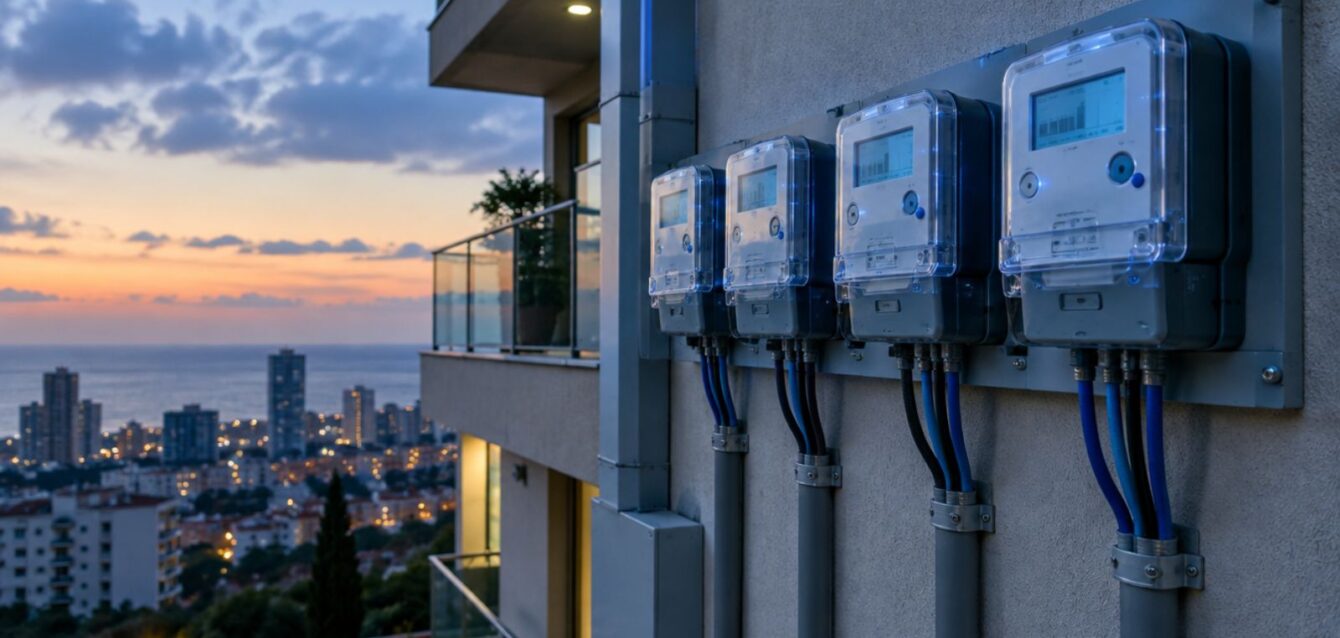
Electricity in Lebanon rarely comes from a single source. A typical building draws power from the public grid when it is available, from a neighborhood or private generator for the rest of the day, and increasingly from rooftop solar panels with batteries. Measuring who consumed what, from which source, and billing it fairly is a daily headache for utilities, generator operators, municipalities and building owners. A smart meter system in Lebanon solves this by replacing manual readings and estimates with accurate, automatic data. This guide explains how such a system works, what it costs to run, and how to deploy it successfully.
What is a smart meter system?
A smart meter system has three layers. The first is the meters themselves: digital electricity meters installed at each subscriber, apartment or distribution board. The second is the communication network that carries readings from the meters to a central platform, using technologies such as LoRa, M-Bus, Wireless M-Bus or cellular. The third is the software platform, sometimes called advanced metering infrastructure (AMI) or a meter data management system, which stores readings, manages devices and subscribers, produces bills and shows dashboards.
Most of the business value lives in that third layer. Meters produce numbers; the platform turns them into invoices, alerts and decisions.
Core capabilities to expect
Remote meter reading
Readings arrive automatically at a set interval, from every fifteen minutes to once a day. Field staff no longer walk building to building with notebooks, estimates disappear and billing disputes drop sharply because every subscriber’s consumption is recorded with a timestamp.
Prepaid metering
Prepaid electricity lets subscribers buy credit in advance and consume until it runs out. For operators it removes collection risk; for subscribers it gives control over spending. The platform tracks balances, sends low-credit alerts and can limit supply when credit is exhausted, following the rules you define.
Remote connect, disconnect and load limits
Many smart meters include a relay. Operators can connect new subscribers, disconnect for non-payment or set an ampere limit remotely, without sending a technician. This is particularly useful for generator operators who sell supply by ampere subscription.
Tamper detection and loss reduction
Meters report cover openings, magnetic interference, reverse flow and unusual drops in consumption. Combined with analytics that compare a feeder’s total supply with the sum of its meters, the system pinpoints theft and technical losses.
Subscriber billing
The platform applies tariffs, fixed fees and taxes, and generates invoices automatically. It can bill different tariffs for grid, generator and solar energy, and it can send bills by SMS, WhatsApp or email. Integration with accounting systems avoids double entry.
Energy analytics
Load profiles show peak hours, average consumption per subscriber and the impact of tariff changes. For buildings with solar, analytics show how much demand is covered by panels and how much still comes from the generator.
Who benefits
- Utilities and concessions: accurate billing, reduced losses and better grid planning.
- Generator operators: fair kWh billing instead of rough ampere estimates, and faster collections.
- Building owners and property managers: fair splitting of consumption between tenants and common areas.
- Municipalities: visibility over public lighting and municipal buildings.
- Factories and commercial sites: sub-metering per line, floor or tenant to control costs.
Choosing meters and communication
Pick meters that support open protocols, so you are not locked into one vendor’s software. For dense urban buildings, Wireless M-Bus or wired M-Bus to a building gateway works well. For readings spread across a town, LoRa gateways cover kilometers with low power. Cellular connections suit isolated sites. Our article comparing LoRa, M-Bus and Wireless M-Bus goes deeper into this choice.
Rolling out a smart meter system
- Define goals: accurate billing, prepaid supply, loss reduction or all three.
- Survey sites: map distribution boards, meter locations and signal coverage.
- Run a pilot: install a few dozen meters, validate readings against manual checks and test billing.
- Prepare subscribers: explain the change, the new bills and how prepaid credit works.
- Scale in phases: expand building by building, monitoring communication success rates.
- Integrate: connect billing to accounting and payment channels.
Costs and return on investment
The main costs are meters, gateways, installation, platform licensing or development, and ongoing hosting and support. Returns come from eliminated reading labor, reduced losses, faster collections and fewer disputes. Operators that previously estimated bills often find that accurate metering alone recovers a significant share of unbilled energy. Measure your current losses and collection delays before the project so you can prove the gain afterward.
Security and data privacy
Connected meters are part of critical infrastructure. Use encrypted communication, change default credentials, restrict who can send disconnect commands and keep an audit log of every remote action. Consumption data reveals household habits, so protect it like any personal data.
Software Senior’s experience
Software Senior designs custom electronic boards and the software around them. We built a smart meter management solution covering reading, installation and removal workflows for field teams and back office. For more context on the Lebanese market, read how IoT is changing electricity and generator billing in Lebanon.
Frequently asked questions
Do smart meters need internet in every apartment?
No. Meters usually talk to a building or area gateway over M-Bus, Wireless M-Bus or LoRa, and only the gateway needs an internet connection.
Can a smart meter system bill grid, generator and solar separately?
Yes. With the right metering points and tariffs, the platform can calculate and invoice each source separately.
How long does a pilot take?
A pilot with a few dozen meters typically runs for several weeks, long enough to validate readings over a full billing cycle.
Learn more about our IoT and electronic boards services.
Common deployment problems and how to avoid them
Weak radio coverage in basements and meter rooms is the most frequent issue, so test signal strength during the site survey rather than after installation. Inconsistent meter IDs between the field team and the billing system cause invoices to land on the wrong subscriber; use barcode scanning at installation to link each meter to the right account. Finally, subscribers who do not understand the new bills will call your office, so prepare a short explanation sheet and a WhatsApp number for questions during the first two billing cycles.
Work with Software Senior
Software Senior is a Beirut-based software development, AI and IoT company with more than 15 years of experience in healthcare, insurance, government, energy and enterprise projects. Request a free consultation, call +961 3 014416 or email [email protected]. Answers to common questions are in our FAQ.